Home

Sugar is the ‘alcohol of the child’, yet we let it dominate the breakfast table 

Leave a comment

With kids consuming half their sugar quota first thing, it’s no wonder they’re getting diabetes and liver disease. We have to fight corporate interests

Breakfast is considered by most nutrition experts, including Public Health England, to be the most important meal of the day. It gets your brain and your metabolism going, and it suppresses the hunger hormone in your stomach so you won’t overeat at lunch. But in our busy lives, it’s easy to turn to what is quick, cheap, or what you can eat on the go. Cold cereal. Instant oatmeal. For those die-hard “I’m gonna serve something hot for breakfast” types, it’s microwaveable breakfast sandwiches. Gotta get out the door now? Granola bars. Protein bars. Yoghurt smoothies.

Sadly, as the National Diet and Nutrition Survey found, what you’re really doing is giving your children a huge sugar load while sending them on their way: half of their daily intake on average. There’s a reason that the World Health Organisationand the United States Department of Agriculture have provided upper limits of sugar – because dietary sugar fries your kids’ liver and brain; just like alcohol.

Alcohol provides calories (7kcal/g), but not nutrition. There’s no biochemical reaction that requires it. When consumed chronically and in high dose, alcohol is toxic, unrelated to its calories or effects on weight. Not everyone who is exposed gets addicted, but enough do to warrant taxation and restriction of access, especially to children. Clearly, alcohol is not a food – it’s a dangerous drug, because it’s both toxic and abused.

Dietary sugar is composed of two molecules: glucose and fructose. Fructose, while an energy source (4kcal/g), is otherwise vestigial to humans; again, there is no biochemical reaction that requires it. But fructose is metabolised in the liver in exactly the same way as alcohol. And that’s why, when consumed chronically and at a high dose, fructose is similarly toxic and abused, unrelated to its calories or effects on weight. And that’s why our children now get the diseases of alcohol (type 2 diabetes, fatty liver disease), without alcohol. Because sugar is the “alcohol of the child”. Also similar to alcohol, sugared beverages are linked to behavioural problems in children

Source: Sugar is the ‘alcohol of the child’, yet we let it dominate the breakfast table | Robert Lustig | Opinion | The Guardian

A Month Without Sugar 

Leave a comment

It is in chicken stock, sliced cheese, bacon and smoked salmon, in mustard and salad dressing, in crackers and nearly every single brand of sandwich bread. It is all around us — in obvious ways and hidden ones — and it is utterly delicious.

It’s sugar, in its many forms: powdered sugar, honey, corn syrup, you name it. The kind you eat matters less than people once thought, scientific research suggests, and the amount matters much more. Our national sugar habit is the driving force behind the diabetes and obesity epidemics and may be a contributing factor to cancer and Alzheimer’s.

Like me, you’ve probably just finished a couple of weeks in which you have eaten a whole lot of tasty sugar. Don’t feel too guilty about it. But if you feel a little guilty about it, I’d like to make a suggestion.

Choose a month this year — a full 30 days, starting now or later — and commit to eating no added sweeteners. Go cold turkey, for one month…

Sunshine and proposals at finishing line on record day – Independent.ie

Leave a comment

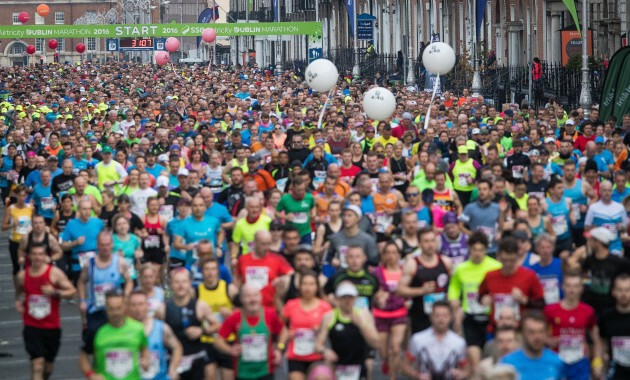
A view of the start of the Dublin MarathonA view of the Dublin Marathon as runners make there way down Fitzwilliam Street Upper

A view of the Dublin Marathon as runners make there way down Fitzwilliam Street Upper

Peter Joseph Singhatey, from Dublin, gets some help at the end. Photos: Damien Eagers

Under glorious blue skies, 19,500 runners took advantage of Ireland’s Indian summer yesterday to compete in the Dublin City Marathon.

Now the fourth largest marathon in Europe, a record number of runners wound their way through the capital, with approximately 17,000 crossing the finishing line at Merrion Square.

Exhausted runners were given a hero’s welcome by family, friends and supporters at the finish line and were presented with a special medal commemorating the centenary of the 1916 Rising and the 37th annual run.

Among the competitors, aged between 18 and 86, it was a triumvirate of Ethiopians who crossed the finish line in record time.

Read more: Up to 17,000 turn out for Dublin marathon spectacular

Source: Sunshine and proposals at finishing line on record day – Independent.ie

Obesity costs global economy an estimated €2tn a year

Leave a comment

Obesity costs global economy an estimated €2tn a year.

The global cost of obesity outweighs that of alcoholism, drug use or road accidents and closely rivals that of armed conflict and smoking, according to a new study.

The cost of obesity is estimated at $2 trillion – equivalent to 2.8 per cent of the world’s economic output, the study found. This makes it one of the top three global social burdens behind smoking and armed violence, war and terrorism..

The research, which was carried out by consultancy firm McKinsey, reveals that obesity is now responsible for about 5 per cent of all deaths a year worldwide.

More than 2.1 billion people – equivalent to nearly 30 per cent of the global population- are overweight or obese. That is almost two and a half times the number of adults and children who are undernourished.

A number of studies conducted in Ireland show that two out of three Irish adults, and one in four primary school children, are overweight or obese.

“Obesity is a major global economic problem caused by a multitude of factors. Today obesity is jostling with armed conflict and smoking in terms of having the greatest human-generated global economic impact,” the report said…

The Ethics of Infection – NYTimes.com

Leave a comment

The Ethics of Infection – NYTimes.com.

“PRIMUM NON NOCERE” or “First, do no harm” is supposed to be the guiding principle of health care workers. And within civil societies, at least, not harming others is considered every person’s moral, ethical and even legal responsibility.

The heated debate over whether it’s responsible for health care workers who treated Ebola patients to go grocery shopping or bowling or get on a cruise ship before the end of the disease’s 21-day incubation period raises a larger question: What is everyone’s duty to prevent transmission of infectious diseases?

Is it ethical to go to the gym when you have a cold, visit a nail salon when you have a foot fungus or board an airplane with a stomach bug? What about the morality of sending your kids to school when they have, say, a green runny nose or were not vaccinated? Are you a bad person if you don’t get a flu shot?

When it comes to “do no harm,” the problem is defining harm and the risk of inflicting it, as well as what constitutes reasonable measures to impose on someone to minimize that risk.

“Risk is a function of two things — probability that harm will occur and severity of that harm, should it transpire,” said Lawrence O. Gostin, a professor of law at Georgetown University who specializes in public health law and human rights.

And those two factors, he said, have a rough inverse relationship. That is, the more severe the potential harm, the less probability, or risk, we are willing to assume — much less allow someone else to assume on our behalf…

What Causes Weight Gain – NYTimes.com

2 Comments

What Causes Weight Gain – NYTimes.com.

If I ask you what constitutes “bad” eating, the kind that leads to obesity and a variety of connected diseases, you’re likely to answer, “Salt, fat and sugar.” This trilogy of evil has been drilled into us for decades, yet that’s not an adequate answer.

We don’t know everything about the dietary links to chronic disease, but the best-qualified people argue that real food is more likely to promote health and less likely to cause disease than hyperprocessed food. And we can further refine that message: Minimally processed plants should dominate our diets. (This isn’t just me saying this; the Institute of Medicine and the Department of Agriculture agree.)

And yet we’re in the middle of a public health emergency that isn’t being taken seriously enough. We should make it a national priority to create two new programs, a research program to determine precisely what causes diet-related chronic illnesses (on top of the list is “Just how bad is sugar?”), and a program that will get this single, simple message across: Eat Real Food…

Always Hungry? Here’s Why – NYTimes.com

1 Comment

Always Hungry? Here’s Why – NYTimes.com.

FOR most of the last century, our understanding of the cause of obesity has been based on immutable physical law. Specifically, it’s the first law of thermodynamics, which dictates that energy can neither be created nor destroyed. When it comes to body weight, this means that calorie intake minus calorie expenditure equals calories stored. Surrounded by tempting foods, we overeat, consuming more calories than we can burn off, and the excess is deposited as fat. The simple solution is to exert willpower and eat less.

The problem is that this advice doesn’t work, at least not for most people over the long term. In other words, your New Year’s resolution to lose weight probably won’t last through the spring, let alone affect how you look in a swimsuit in July. More of us than ever are obese, despite an incessant focus on calorie balance by the government, nutrition organizations and the food industry.

But what if we’ve confused cause and effect? What if it’s not overeating that causes us to get fat, but the process of getting fatter that causes us to overeat?

The more calories we lock away in fat tissue, the fewer there are circulating in the bloodstream to satisfy the body’s requirements. If we look at it this way, it’s a distribution problem: We have an abundance of calories, but they’re in the wrong place. As a result, the body needs to increase its intake. We get hungrier because we’re getting fatter.

The Rise of Antibiotic Resistance – NYTimes.com

Leave a comment

The Rise of Antibiotic Resistance – NYTimes.com.

“The World Health Organization has surveyed the growth of antibiotic-resistant germs around the world — the first such survey it has ever conducted — and come up with disturbing findings. In a report issued late last month, the organization found that antimicrobial resistance in bacteria (the main focus of the report), fungi, viruses and parasites is an increasingly serious threat in every part of the world. “A problem so serious that it threatens the achievements of modern medicine,” the organization said. “A post-antibiotic era, in which common infections and minor injuries can kill, far from being an apocalyptic fantasy, is instead a very real possibility for the 21st century.”

The growth of antibiotic-resistant pathogens means that in ever more cases, standard treatments no longer work, infections are harder or impossible to control, the risk of spreading infections to others is increased, and illnesses and hospital stays are prolonged.

All of these drive up the costs of illnesses and the risk of death. The survey sought to determine the scope of the problem by asking countries to submit their most recent surveillance data (114 did so). Unfortunately, the data was glaringly incomplete because few countries track and monitor antibiotic resistance comprehensively, and there is no standard methodology for doing so.

Still, it is clear that major resistance problems have already developed, both for antibiotics that are used routinely and for those deemed “last resort” treatments to cure people when all else has failed…”

Older Entries Newer Entries

Bring Your Own Brain

How to make the best use of your neck-top computer.

The Cerebral Hedonist

"Can You Match My Resolve"

Delusional Bubble

Your travel guide to the fantastic unknown places around the world.

Anil Blon

Director at Natraj Trekking

MAJAALIFEE

I love to write about everything. Writing relaxes me.

TORINO NELLA RETE

Ogni settimana un articolo per riflettere e discutere - Luigi Bacco

Mikki Senkarik

Original Oil Paintings in Progress

Journeys with Eileen Diane

Photos, travel, armchair travel, cat tales, random thoughts

What's on Sid's mind

Recollect. Reimagine. Express

Lifesfinewhine

The Life & Ramblings Of A Zillennial

Thoughtsnlifeblog

Change your thoughts and transform your life

Something to Ponder About

Human Created Content - Creative Writing - Australia

Jane's Lens

Jane Lurie Photography

The Creative Flux

Architectural, interior and garden design, cool materials and resources, and other things that matter to me

Perception

A journey into the labyrinth of my sceptical mind.

Flutter & Hum

Reflections, observations and adventures of a garden geek